

You never forget your first. Do you? It was the perfect match. She loved the way I sounded, I loved the way she made me feel. We spent a whole lot of time together and often flirted with the idea of having a more committed relationship. But, nothing ever came of it and as I grew older it got worse. I had a lot more things demanding my time and attention, and I didn’t think I had the time or luxury to give her what she needed, so the best I could offer was something non-committal.
Over time, we started to drift apart, as anyone would expect, and the period between each visit would be longer than the previous. I could sense the chemistry between us and the pull I once had on her slowly thawing away, but she could do no wrong by me, she, remained perfect in every way that mattered.
Recently, I’d been thinking a lot about her. And like an earworm, I couldn’t get her out of my mind. I realized how good we had it, and how the world seemed slightly brighter when she was with me. So I reached out, she obliged and we spent some time together, reliving old memories, and talking about former and current partners. This continued for a while. And eventually, I had to ask myself the inevitable question, “Do I want to give us another shot?” I did!
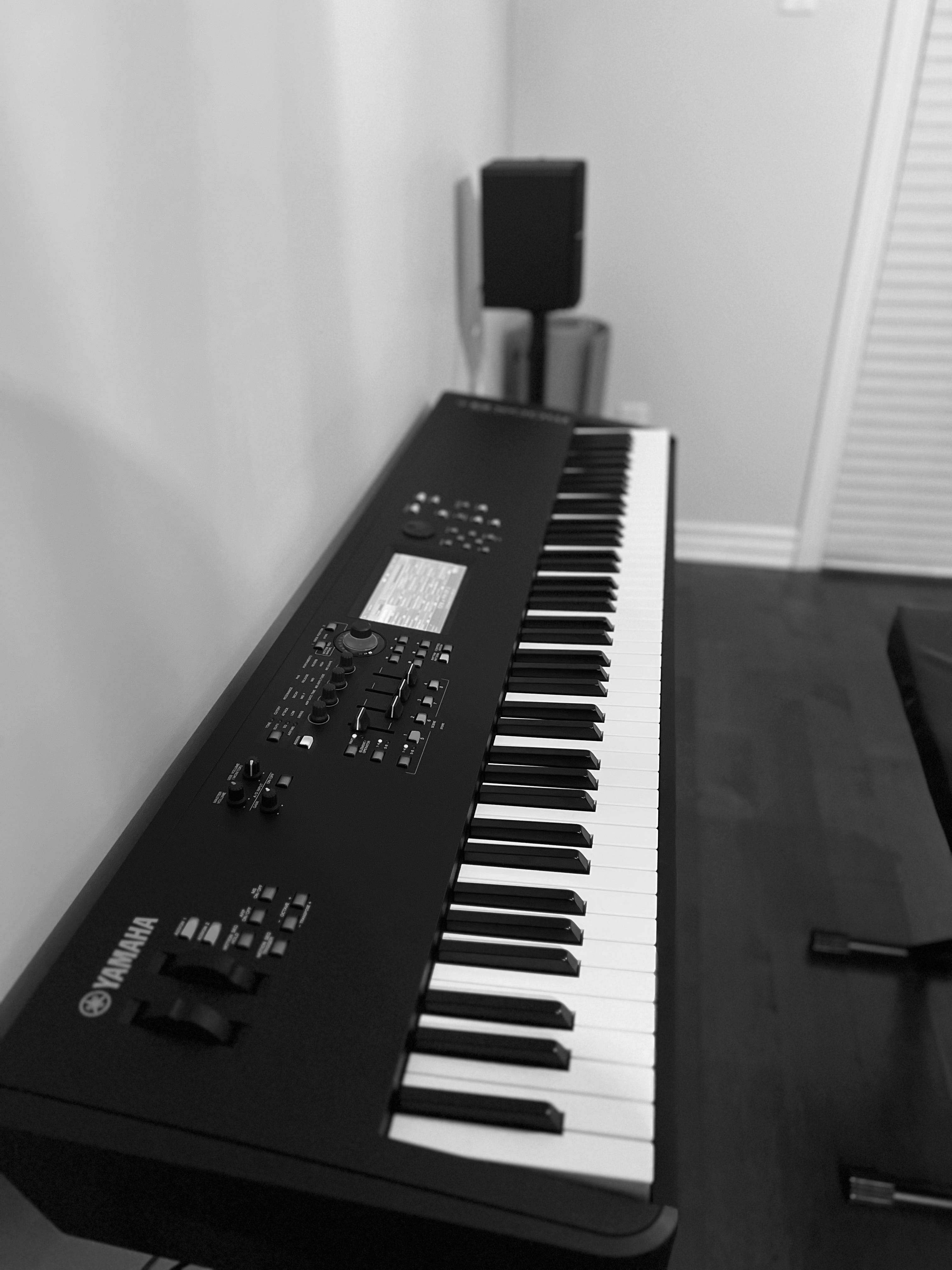
But I’m much older now, and she’s always loved younger men for obvious reasons. I’m a bit stuck in my ways, and I can’t go at it for hours like I did when I was much younger, but she didn’t care, she wanted me as I was. I still couldn’t promise anything serious of course. I still had a lot demanding my attention, but I was willing to give us a chance, meet more often and see where it goes. So I did the most reasonable thing a man in my predicament would do to show an increased level of commitment. I walked into the nearest Long and Mcquade shop and got a weighted 88-key piano, in an attempt to rekindle the relationship I had, with my old flame - music.
So, what (or who) is music? According to Wikipedia, “music is the arrangement of sound to create some combination of form, harmony, melody, rhythm, or otherwise expressive content”.
Music is so ubiquitous, that it could hold a different meaning depending on who you ask. It could be a drug because It could make you feel hyped, pained, inspired, angry, jealous, loved, brave etc. It could be a language because it allows you to communicate and express ideas that words alone cannot convey. It could be therapy; If you need to feel a sense of calm, it’s got you, if you need to feel affirmed, it’s got you too, you want to be lost in your thoughts? It’s got you covered as well. But to me, to repurpose the words of Dani Rojas from Ted Lasso, music is life! I simply cannot conceive the idea of a world without it.
…Music is life.
And I strongly believe that practitioners of music, people who’ve honed their craft, are modern-day sorcerers. There’s a reason why people think they’ve found the love of their lives when they listen to the likes of Kotrell and Johnny Drille, believe they’ve found God when they listen to a song by Hillsong, convinced they can spar with a bear and come out alive when they listen to Eminem, convinced that football is life, as well as a deep sense of pride in one’s nationality when they listen to Wavin’ Flag by K’naan. A music sorcerer can and will make you feel however they want to. And nudge you to do things you might not do otherwise.
Now, you might be thinking, “Bruv, chill. It’s just music, it’s not that deep“. To which I’d have to say, it is in fact that deep. Have you listened to a Quartet play live? Fam, I recently did. It was so moving, heartstrings were being pulled that I didn’t even know existed. No lyrics, just 4 humans playing two violins, a viola and a Cello. And yet the room was filled with so much emotion, it could barely be contained. If I wasn’t interested in knowing more about music before, I was after that.
So, I began my quest to better understand music by learning how to play the piano. Initially, it felt daunting because how does anyone make cohesive and pleasant sounds come out of this? How do I know what keys make sense together? How do I get to the point where I can play things without looking at the keys? So some research ensued, and I ended up taking an online course, and have been doing so for the past 4 months.
In that time I’ve learned a great deal. And for a person who says they like music, you’d think I’d know a little bit more on the subject before now - I did not! So like programming or anything else really, it was a good idea to know what the music primitives were. To do that, I needed to learn a bit of music theory. Some of the concepts that I now have a better grasp of are Notes, Chords, Chord Progressions, Scales and the number system. So allow me to bore you a bit with what they mean and maybe in the end you’d appreciate music a little bit more.
A music sorcerer can and will make you feel however they want [you]to.
Notes, what are they? In simple terms, these are the sounds that the individual keys on the piano make. A note represents a specific pitch and duration of a sound. There are 7 distinct white keys, and 5 distinct black keys, making a total of 12 keys repeated multiple times across the piano. The white keys are labelled C, D, E, F, G, A and B. The black keys depending on what side they’re on in relation to the white keys are either flat(left) or sharp(right), e.g. the black key on the right-hand side of C is called C sharp and that same key, because it’s to the left of D, can also be called D flat. When the keys repeat themselves going to the right of the piano, the pitch increases (higher octaves), and towards the left, the pitch decreases (lower octaves).
Chords, on the other hand, are a combination of 3 or more notes. For example, if you play keys C, E and G together, that’s a chord - the C major Chord. There are different types of Chords, but the ones I’m familiar with at the moment are the major chords like the earlier example, which tend to sound happy and the Minor chords, which tend to sound sad or scary. If you play keys C, E flat, and G together, that would be a C Minor chord, which you could say is the opposite of the C major chord. There’s a formula for this, but I won’t be getting into that here.
Chord Progressions, this is when you combine one or more Chords. It can form a significant part of what you’d consider music. For example, if you played C major, G major, A Minor, and the F major chords in succession, that’s a chord progression and a very popular one at that, known as the 1, 5, 6, 4 pattern.
Next up, Scales. These are used to Identify a sequence of notes that ascend or descend in pitch. They are typically associated with one of the keys on the piano. And like chords, there are different types of scales, but the ones I’m familiar with right now are the major and minor scales, which both typically have 7 notes. For example, the C major scale includes the notes C, D, E, F, G, A, and B, and the A minor scale includes the notes A, B, C, D, E, F, and G. Understanding this concept was pretty cool because it now made all the sense in the world when someone would say to an instrumentalist, "I sing in D" or “Play this song in D minor“. They simply meant that for the given song, only notes that belong to that scale should be played. There’s a formula for determining the notes that belong to a scale, but again, I won’t be getting into that here.
Finally, the Number System. This describes what pattern should be played on any given scale. It uses the interval (i.e. distance) between keys as a descriptor. In explaining what a chord progression was, I mentioned the 1, 5, 6, 4 pattern. With our newfound knowledge of notes, chords and scales, let’s apply the 1, 5, 6, 4 pattern to the C major scale. To recap, the C major scale includes the notes C, D, E, F, G, A, and B. So 1 would be C (C major chord), 5 would be G (G major chord), 6 would be A (A minor chord), and 4 would be F (F major chord). You can apply the same pattern to a different scale, for example, the A minor scale and it would work just fine.
Knowing these primitives gave me an insight and appreciation for music I didn’t previously have. I could now combine different chords to make sounds that weren’t bad to listen to, and I could claim the status of an amateur musician. It also made it obvious that music is a combination of chord progressions and melodies - the part of music you whistle to. Melodies sound good on their own, but when you add chord progressions, you give the arrangement an extra oomph.
And the more I practice and learn, the more appreciation I gain. One of the coolest things that’s happened since I started this, is when I listen to some of my favourite songs, I can hear the pattern being used. For example, rocking back and forth between two notes in a power chord - the shell of a chord. For example, C & G of the C major chord, or the use of arpeggios - playing individual notes in a chord and ending with the root note. Other times, I hear things that wow me, and I’m curious as to how I could reproduce that on the piano. I read a book recently that said “It’s not what you look at that matters, it’s what you see”, and in the same vein it’s not what you listen to that matters, it’s what you hear. And I’ve been hearing a whole lot lately.
…it’s not what you listen to that matters, it’s what you hear.
It’s been such a fun and interesting journey so far and there are still so many things I’m yet to learn. Like being able to play a song or melody by ear, being able to immediately recognize the key a person is singing on and accompanying them, being able to sight read well enough to play my favourite songs, learning the art of making a good musical composition etc. I look forward to not just being better at the piano but also improving my knowledge of music in general.
Ultimately, I’m glad my old flame and I are working it out. And I’m curious to see how far we take it.
Lovely piece!
I really enjoyed the voiceover with the backing track! It really brought this to life :D